
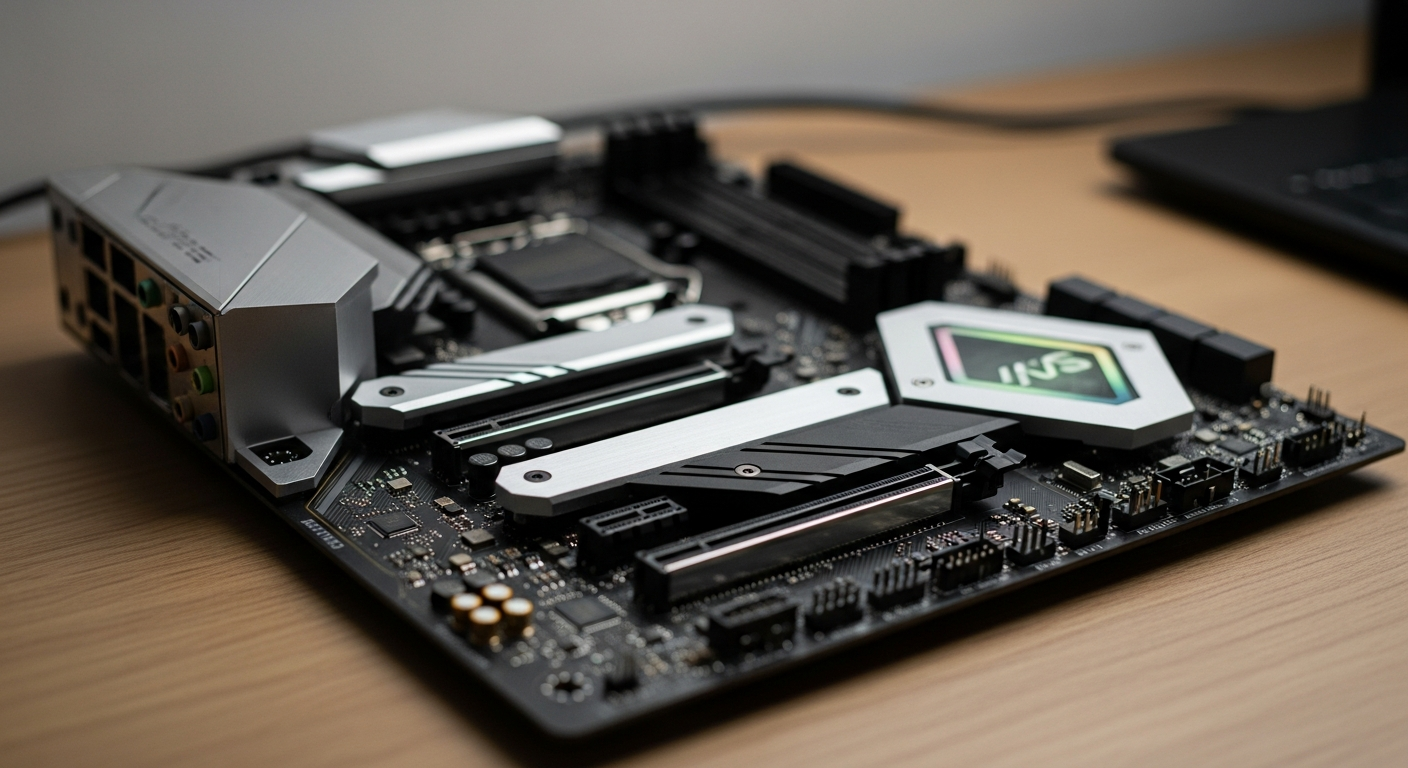
GIGABYTE's B550 X Series Brings Wi-Fi 7 to the AM4 Platform
GIGABYTE's new AORUS B550 X Series motherboards pair modern connectivity with the Ryzen 7 5800X3D, offering a refreshed AM4 build path at a lower cost than next-gen platforms.
A Familiar Socket Gets a Modern Makeover
The AM4 platform refuses to retire gracefully, and GIGABYTE seems perfectly fine with that. On July 30, the company announced its AORUS B550 X Series motherboards, a lineup it describes as the most powerful refresh of the AM4 platform to date. The boards are built specifically around the AMD Ryzen 7 5800X3D, a processor GIGABYTE calls “the best cost-to-performance processor on the market,” and they arrive loaded with features that would have felt right at home on a next-generation board.
The headline addition is Wi-Fi 7, which is a genuinely surprising inclusion for a DDR4-era platform. According to GIGABYTE, the implementation supports ultra-wide 160 MHz channels, 4K-QAM modulation for higher throughput, and Multi-Link Operation, which intelligently distributes bandwidth across frequency bands. The company says deterministic low latency is also part of the package, keeping online gaming and video calls responsive under real-world conditions.
For a board targeting budget-conscious builders who already own or are eyeing a 5800X3D, bringing Wi-Fi 7 to the table instead of asking them to jump to AM5 is a pragmatic pitch.
Power Delivery Built for the 3D V-Cache Era
The 5800X3D is not a power-hungry chip, but it does have a massive 96 MB L3 cache that needs stable, clean voltage to do its best work. GIGABYTE says the B550 X Series addresses this with a 10-phase, 60 A DrMOS VRM design. The use of Driver-MOSFET technology, the company claims, allows the board to run up to 20 degrees Celsius cooler than general powerPak designs under the same workload.
The thermal story does not stop at the VRM. A redesigned heatsink offers four times the cooling surface area of standard designs, paired with premium 5 W/mK thermal pads for heat dissipation. Dedicated M.2 heatsinks are included to keep high-speed storage from throttling, and a full-coverage one-piece back plate that GIGABYTE calls the UD Base Plate adds structural rigidity while also helping move heat away from the board.
It is the kind of over-engineering that makes sense when the goal is squeezing the last drops of performance from a platform that launched in 2019.
Quality-of-Life Features That Actually Matter
GIGABYTE has also folded in its “EZ” feature set across the board, and the details here are worth a closer look for anyone who has wrestled with PC assembly.
The WIFI EZ-Plug replaces the traditional threaded antenna connector with a plug-and-play design, sparing builders the knuckle-bruising ritual of screwing on antenna leads in tight spaces. M.2 EZ-Latch Click and EZ-Latch Plus bring screwless installation to both M.2 drives and their heatsinks, which will be welcome news to anyone who has fumbled with a tiny M.2 retention screw under poor lighting. PCIe EZ-Latch Plus provides a quick-release mechanism for graphics cards, solving a problem that has quietly frustrated builders for years.
These are not flashy features, but they reflect an understanding of where the friction actually lives in a real build.
Lineup and Availability
The B550 X Series will launch in Gaming, Eagle, and Elite tiers, each available in ATX and microATX form factors, according to GIGABYTE. The company says the models will become available in succession, without specifying exact dates or pricing in the announcement.
The broader context here is worth noting. As reported by TechPowerUp, AMD relaunched the Ryzen 7 5800X3D as an AM4 10th Anniversary Edition earlier this year, and AMD also formally announced an extended AM5 socket longevity commitment through 2029. The B550 X Series lands in that environment as a clear argument that the older platform still has life, particularly for gamers who want strong per-core performance without the cost of a full platform upgrade.
Whether the Wi-Fi 7 addition is enough to move the needle for builders sitting on older B550 boards is a fair question. For first-time AM4 builders or those starting fresh with a 5800X3D, the combination of modern wireless, serious thermal management, and screwless assembly features makes this a notably more compelling package than a straightforward board refresh would have been.
What processors is the GIGABYTE B550 X Series designed for?
According to GIGABYTE, the B550 X Series was purpose-engineered around the AMD Ryzen 7 5800X3D, which features 8 cores, 16 threads, and 96 MB of L3 cache.
Does the GIGABYTE B550 X Series support Wi-Fi 7?
Yes. GIGABYTE says the B550 X Series includes Wi-Fi 7 connectivity with 160 MHz channels, 4K-QAM, and Multi-Link Operation for improved wireless throughput and low latency.
What form factors will the B550 X Series come in?
According to GIGABYTE, the lineup will include Gaming, Eagle, and Elite models across both ATX and microATX form factors.
How does the VRM cooling compare to standard designs?
GIGABYTE claims the B550 X Series VRM heatsink offers four times the cooling surface area of standard designs and can run up to 20 degrees Celsius cooler than general powerPak boards when paired with the 5800X3D.